|
We emerged on the road near Bigging Farm and found that the Lyemira Bay in Harray Loch was awash with waterfowl, mostly Wigeon but surprisingly very substantial numbers of Coots, probably in excess of 300. We were now on the west side of Bosquouy where flocks of Golden Plover and Lapwings were roosting. A single Raven kept a watchful eye as the Sun began to set. Our return to the Lay-bys caused some Moorhens to scuttle to cover, and it was time for us to do the same.
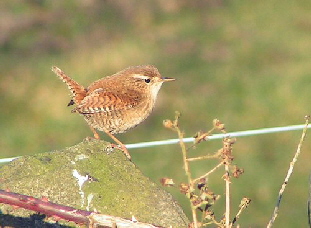
The Wren: King of Birds and Christmas Folklore
The wren, the wren the king of all birds
St. Stephen's Day was caught in the firs.
Although he is little, his honour is great
Jump up me lads and give us a treat!
All the wise Winter Wrens in the Medieval British Isles did their best to spend the day after Christmas, the feast of St. Stephen, still and quiet, deep in their favourite hedgerow for the "Wrenboys" were out to get them. Each year, on the morning of December 26th, a mob of boys chased the first Winter Wren they found through ditches and hedges, over hill and dale, until the bird dropped dead from exhaustion and fright or one of the boys got close enough to deliver a good smack with a stick. Once they had their wren, the bird was stuck on a pole and paraded around town while the Wrenboys sang the Wren Song. If the people of the town knew what was good for them, when the Wrenboys appeared on their doorstep, they gave them a treat of food or drink in exchange for a feather plucked from the body of the wren.
This ritual called "Hunting the Wren" or sometimes just "The Wren," was held in honour of St. Stephen, the first Christian martyr. According to Irish folklore, when St. Stephen was running for his life from the mob intent on killing him, he saw a holly bush that he figured would make a perfect hiding place. Sure enough, the mob ran past the holly bush and Stephen breathed a sigh of relief. Just then, a Winter Wren began flapping his wings and calling noisily. The mob turned on its heels, found Stephen, and ensured his martyrdom.
Celtic tribes hunted the wren for centuries before the first Christian missionaries arrived on Ireland's shores. But their motivations were a little different from those of their descendants. Like many of our aspiring politicians today, the Celts were in favour of time limits for their leaders. Every seven years the Celtic king was ritually sacrificed at a public ceremony in order to make way for the new king. The wren, as king of the birds, was a protected creature, but on the day the king was killed, a wren would also be sacrificed and put on parade. If you couldn't get close enough to see the real sacrifice, you could at least take part in the symbolic sacrifice. As was the case with many pre-Christian rituals, The Wren was modified in order to comply with the new religious codes. Rather than celebrating the ritual sacrifice of a pagan king, the Christian Saint Stephen became the core around which The Wren practice revolved.
Even further back mythologists conject that the concept arrived in the British Isles during the Bronze age through prehistoric trade routes from the Mediterranean and reflected the death of dark earth powers and the beginning of a new season of light. As the timing coincides with the general midwinter solstice this seems a likely starting point to the tradition.
To discover how the wren became King of the Birds according to folklore, the bird world decided to hold a congress at which they would choose a King. It was put to a vote and agreed that the bird who could fly the highest for the longest amount of time would be crowned King. Off they went, each bird trying to out fly the other. All the birds but the Eagle had soon given up, and the Eagle, too, though triumphant, finally tired and started his descent. At that very moment the Wren leapt from his hiding place in the Eagle's tail, circled up just a little bit higher than his raptor carriage, and stole the crown. Thus the Wrenboys sing,
"Although he is little, his honour is great."
In a version of the story that echoes the St. Stephen myth, a band of Irish warriors sneaking up on a camp of sleeping Vikings were betrayed by a wren that beat its wings on their shields. Likewise, there are numerous versions of the song "Hunting the Wren." Since the wren is a symbol of royalty, singing The Wren song was a safe way for peasants to express their unhappiness with their king without being drawn and quartered. In one particularly bloody version called "Cutty Wren," the wren is killed "With great guns and great cannon," carried away "On four strong men's shoulders," its wings and ribs divided up and given to the people. The revolutionary versions of the wren songs can be traced back to periods of English history marked by social unrest and peasant revolts. Often, characters such as Robin Hood are central figures.
|